Reverse Osmosis Water Explained: How RO Filtration Works & Why It's Our #1 Seller
Reverse osmosis — often just called "RO" — is the most popular water we deliver at Kool Springs, and for good reason. It's clean, crisp, and consistently great-tasting, with virtually all impurities removed. But what actually happens inside a reverse osmosis system, and why do so many Ontario families and businesses choose it over other options?
In this guide we'll break down exactly how RO filtration works, what it removes from your water, how it compares to other water types, and why it's become our #1 seller across Haldimand County, the Niagara Region, and Norfolk County.
What Is Reverse Osmosis Water?
Reverse osmosis is a water purification process that forces water through an extremely fine semipermeable membrane. The membrane's pores are so small — roughly 0.0001 microns — that they block dissolved salts, metals, and other contaminants while allowing pure water molecules to pass through. The result is water that is stripped of nearly everything except pure H2O.
The word "reverse" is key. In nature, osmosis pulls water from a less-concentrated solution toward a more-concentrated one. Reverse osmosis flips that: pressure is applied to push water in the opposite direction — away from the dissolved impurities — leaving purified water on one side and concentrated contaminants on the other, which are flushed away.
Small residential Point of Use - Reverse Osmosis (POU-RO) water treatment units are very effective at removing many chemical contaminants from drinking water. Health Canada, "Ultraviolet & Reverse Osmosis for Micro-Systems"
How Does the RO Filtration Process Work?
A quality reverse osmosis system doesn't rely on the membrane alone. It uses several stages that work together, each targeting a different type of impurity. Here's what happens as water moves through the system:
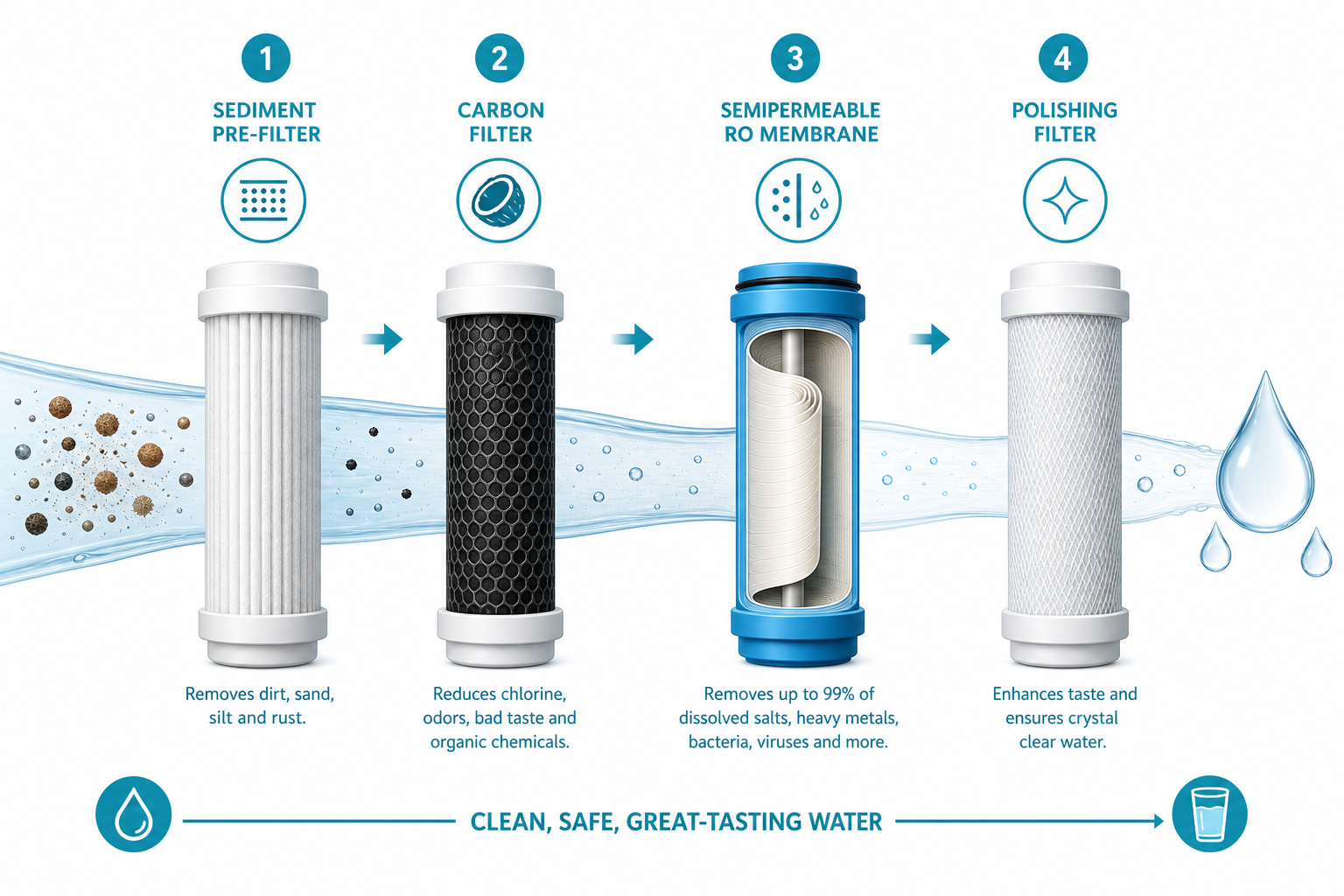
Stage 1: Sediment Pre-Filter
Water first passes through a sediment filter that traps larger physical particles like dirt, sand, silt, and rust. This step protects the more delicate filters downstream from clogging prematurely.
Stage 2: Carbon Filter
Next, an activated carbon filter reduces chlorine, chlorine by-products, unpleasant odours, and organic chemicals that affect taste and smell. Removing chlorine at this stage also protects the RO membrane, which can be damaged by it.
Stage 3: The Semipermeable RO Membrane
This is the heart of the system. Under pressure, water is pushed through the semipermeable membrane, which rejects up to 99% of total dissolved solids (TDS) — including heavy metals, salts, and a wide range of other contaminants. The rejected impurities are carried away in a separate waste stream, while the purified water continues on.
Stage 4: Polishing Filter
Finally, a post-carbon "polishing" filter gives the water a last pass to remove any lingering tastes or odours, ensuring it's crystal clear and fresh before bottling. Many systems also add ultraviolet (UV) treatment as a final safeguard against microorganisms.
What Does Reverse Osmosis Remove From Water?
Reverse osmosis is one of the most thorough filtration methods available. Certified RO systems tested to NSF/ANSI Standard 58 are proven to reduce a broad list of contaminants, including:
- Heavy metals — lead, arsenic, copper, and mercury
- Dissolved salts and minerals — sodium, calcium, and magnesium (the "hardness" minerals)
- Chemical contaminants — nitrates, fluoride, and certain pesticides and industrial chemicals
- Aesthetic issues — chlorine taste and odour, sediment, and cloudiness
- Microorganisms — many bacteria, cysts, and viruses (especially when paired with UV)
This makes RO water an excellent choice for anyone concerned about tap water quality, older plumbing, well water, or simply the taste of their local municipal supply.
Does RO Water Remove Healthy Minerals — And Does That Matter?
Because reverse osmosis removes dissolved solids so effectively, it also removes naturally occurring minerals like calcium and magnesium. Some people wonder whether that's a concern for health. According to Health Canada, it generally isn't for Canadians eating a normal diet:
In Canada, water is a minor source of such minerals when compared to foods. If you eat a reasonably balanced diet, you don't need to take a mineral supplement when drinking water treated with a reverse osmosis system. Health Canada, "Drinking Water and Health: Treatment"
In other words, the minerals you'd get from tap water are minimal compared to what you get from food. If you prefer water with added minerals for taste, our alkaline water and natural spring water are great mineral-rich alternatives — but for pure, clean-tasting hydration, RO is hard to beat.
Why Does Reverse Osmosis Water Taste So Good?
Ask our customers why they love RO and taste comes up again and again. By stripping out chlorine, sediment, and the dissolved minerals that create "hard" or metallic flavours, reverse osmosis produces water with a clean, neutral, refreshing taste. There's nothing to get in the way of that crisp, pure finish.
That neutral profile also makes RO water a favourite for:
- Coffee and tea — pure water lets the true flavour of your beans and leaves shine through
- Cooking and baking — no off-tastes transferred to soups, sauces, or dough
- Ice cubes — clearer, cleaner-tasting ice with no cloudiness
- Everyday hydration — the kind of water the whole family actually wants to drink
How Does RO Water Compare to Our Other Water Types?
Kool Springs offers four types of water so you can choose what suits your household or business best. Here's how reverse osmosis stacks up:
| Water Type | How It's Made | Best For |
|---|---|---|
| Reverse Osmosis | Multi-stage filtration through a semipermeable membrane | Clean, neutral taste; everyday drinking, coffee, cooking |
| Natural Spring Water | Sourced from a natural spring, retaining minerals | Those who prefer a naturally mineral-rich taste |
| Distilled Water | Boiled to steam, then condensed back to pure water | CPAP machines, humidifiers, appliances, specialty uses |
| Alkaline Water | Higher pH (typically 8–9) with added minerals | People seeking a higher-pH, mineral-enhanced option |
Want to see them side by side in more detail? Visit our types of water page to compare all four.
Why Is Reverse Osmosis Our #1 Seller?
RO consistently tops our orders because it delivers exactly what most people want from their drinking water: purity, great taste, and peace of mind, without any fuss. It's a safe, reliable choice for families with kids, for offices keeping staff hydrated, and for anyone who simply wants better water than what comes out of the tap.
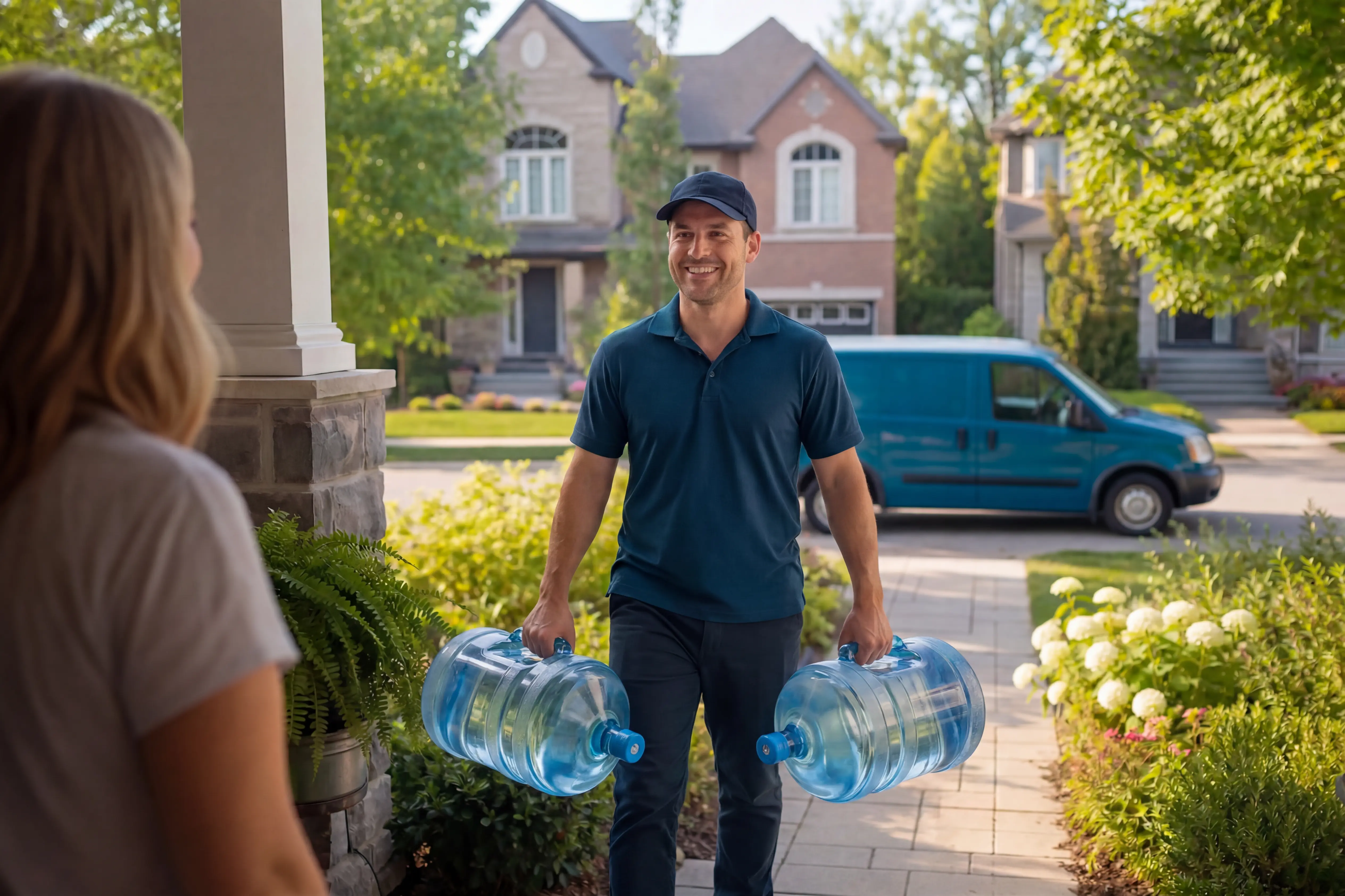
And with Kool Springs, that great-tasting RO water comes straight to your door in reusable, BPA-free bottles. We deliver in convenient 18L (5-gallon) and 11L (3-gallon) sizes. Every bottle we collect is sanitized and refilled in our closed-loop, zero-waste system — so you get pure water without the pile of single-use plastic.
Common Questions About Reverse Osmosis Water
Is reverse osmosis water safe to drink?
Yes. Reverse osmosis is one of the most effective purification methods available and is widely used for drinking water around the world. By removing contaminants like lead, arsenic, nitrates, and chlorine, RO water is a safe, clean choice for daily hydration.
Is RO water the same as distilled water?
Not quite. Both are very pure, but they're made differently. Reverse osmosis pushes water through a membrane to filter out impurities, while distilled water is boiled into steam and then condensed back into liquid. Distilled water is typically chosen for specialized uses like CPAP machines and appliances, while RO is the go-to for great-tasting everyday drinking water.
Does RO water need to be refrigerated?
No. Like any bottled water, RO water is shelf-stable and can be stored at room temperature away from direct sunlight. Many customers keep a bottle on a cooler for hot and cold water on demand — you can learn more on our products page.
Is RO water good for babies and children?
Reverse osmosis water is a clean, low-contaminant option that many families feel good about serving to kids. As always, follow your pediatrician's guidance for infant formula preparation and specific dietary needs.
Getting Reverse Osmosis Water Delivered
Kool Springs has been a family-run business serving our communities for around 30 years. We deliver reverse osmosis water — and our other three water types — right across Haldimand County, the Niagara Region, and Norfolk County. Whether you want a couple of bottles a month or a regular schedule with a cooler, we make it simple.
New to water delivery? Our guide on how bottled water delivery works walks you through ordering, delivery schedules, and bottle exchange step by step.
Ready to get started? Call 1-844-BUY-KOOL, request a free quote, or email info@koolsprings.ca.